

DMR Teams Up with UMass Dartmouth and UMaine to Research Juvenile White Sharks
 BOOTHBAY HARBOR, Maine - The Maine Department of Marine Resources (DMR) is teaming up with researchers from the University of Massachusetts Dartmouth (UMass) and the University of Maine (UMaine) on two research initiatives this year to better understand juvenile white shark presence and habitat use in the Gulf of Maine.
Both projects involve attaching electronic transmitters to white sharks, known as tagging, which allows researchers to track them in the Gulf of Maine. The work is conducted both from research vessels and from shore, with researchers using rod and reel to catch sharks before tagging them.
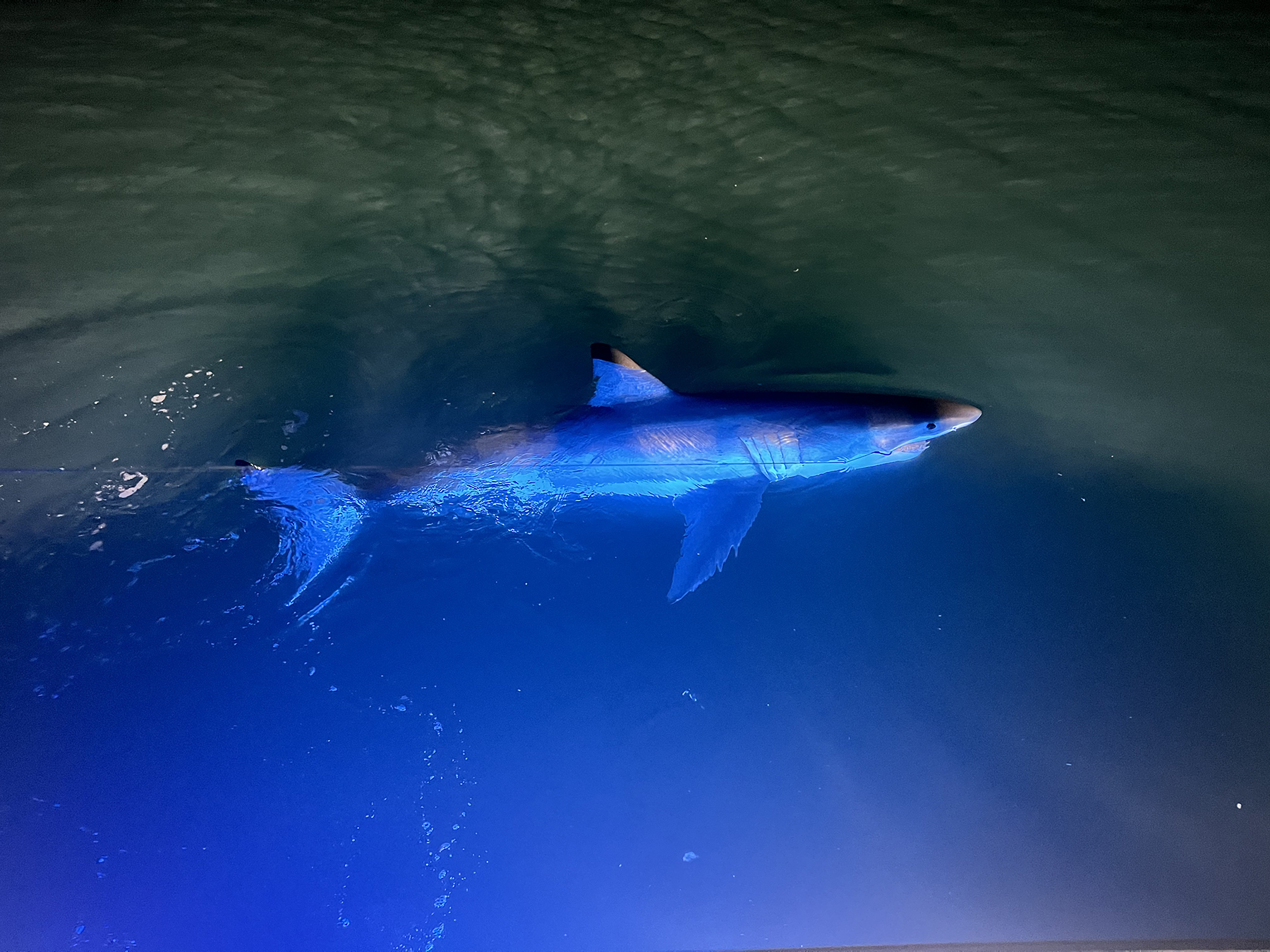
DMR has been conducting boat-based tagging research for different species of sharks and tunas for several years in collaboration with UMaine. However, this is the first year in which a white shark has been successfully tagged by DMR’s lead shark researcher Matt Davis and UMaine Associate Professor of Marine Science Walt Golet. On Wednesday night, the team tagged an 8-foot female juvenile white shark which was given the name “Bug” by Davis. The tags for this research were funded through a grant from the Maine Outdoor Heritage Fund.
Since both projects began in August, three white sharks in total have been tagged by the researchers, including two by the shore-based effort run by UMass Biology Professor Diego Bernal.
DMR began monitoring white shark activity in the Gulf of Maine in 2020, deploying acoustic telemetry receivers which detect white sharks that have been outfitted with transmitters. Currently, the DMR has more than 35 receiver sites deployed between Ogunquit Beach and the US-Canadian border.
Organizations such as the Atlantic White Shark Conservancy (AWSC), Massachusetts Division of Marine Fisheries (MADMF), National Oceanic and Atmospheric Administration (NOAA) and others have been tagging white sharks for more than a decade.
“Both the UMass and UMaine projects will fill in data gaps on the seasonal presence, distribution, and habitat use of white sharks along Maine’s coastline,” said Davis.
“While hundreds of white sharks have been tagged in New England waters, very few have been tagged in Maine waters. Additionally, juvenile white sharks less than 9 feet in length are relatively under-represented in the tagged population,” said Davis.
“Lately, we’re starting to see more juvenile sharks in coastal Maine, which presents a unique opportunity. Maine-based tagging efforts will improve our understanding of local behavioral patterns and will help us learn more about juvenile white shark movement patterns. This would benefit both marine resource management and public safety,” said Davis.
SHORE-BASED RESEARCH
Fishing from shore at night on southern Maine beaches, Bernal will attach transmitters on up to 30 white sharks landed on baited hooks.
Once the shark is caught, biological data and time on the line will be recorded, followed by transmitter attachment and release. Total handling and tagging time will take 5 minutes or less.
BOAT-BASED RESEARCH
Between York Beach and Boothbay Harbor, Davis and Golet will be tagging up to ten juvenile white sharks from research vessels this year.
Once caught, sharks will be brought alongside the boat, and a rope will be used to secure both the head and tail, at which point they will be outfitted with a transmitter before they are released.
PUBLIC SAFETY
Public safety is a priority of both projects which are authorized under special licenses issued by DMR that include stipulations to ensure the safety of beach goers and the safety of sharks.
Shore-based research is restricted to nighttime when beach traffic is limited, and researchers must notify state and local officials including Marine Patrol when fishing.
Both projects include restrictions on how close they can be done to public swimming areas and must be suspended if swimmers are in proximity to fishing gear.
While a modified chumming method using frozen menhaden chunks is allowed from the research vessels, it is not being used in the shore-based research. It is prohibited within two hours of sunrise and if an incoming tide would prevent the chum slick from dispersing at a beach by sunrise. “Safety is paramount,” said Davis. “We’re using the same species fishermen often use as bait in their inshore lobster pots. It’s also important to note that our chumming method doesn’t attract sharks from far away but attracts sharks to the boat which are already in the area.”
“In combination, these two research initiatives will help to fill an important data gap on juvenile white sharks here in the Gulf of Maine,” said Davis. “The more we know about these animals, the better we are able to manage this remarkable species and the more equipped we are to support the safety and enjoyment of visitors to our coastal beaches and waters.”
***
CAPTION FOR PHOTO: "Bug," an 8-foot female juvenile white shark is the first tagged by DMR and UMaine
Legal Disclaimer:
EIN Presswire provides this news content "as is" without warranty of any kind. We do not accept any responsibility or liability for the accuracy, content, images, videos, licenses, completeness, legality, or reliability of the information contained in this article. If you have any complaints or copyright issues related to this article, kindly contact the author above.
