

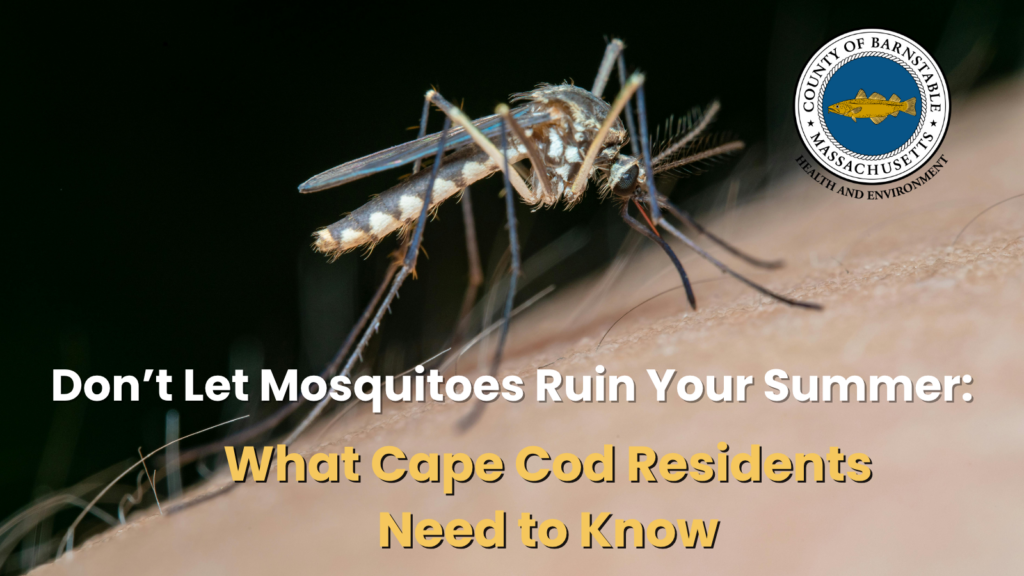
Don’t Let Mosquitoes Ruin Your Summer: What Cape Cod Residents Need to Know
Published on: June 30, 2026
By Marina Tonial, MPH, CHES®, Community Health Educator
Summer on Cape Cod means beach days, farmers markets, and outdoor adventures — but it also means mosquito season. As temperatures rise and rain creates standing water, mosquitoes become more active, and with them comes the risk of mosquito-borne viruses like West Nile Virus (WNV) and Eastern Equine Encephalitis (EEE). Here’s what you need to know to protect yourself and your family this summer.
What Are We Watching For on Cape Cod?
The Barnstable County Department of Health and Environment monitors for two main mosquito-borne viruses each season:
West Nile Virus is the more common of the two. In 2025, Massachusetts recorded 451 WNV-positive mosquito samples statewide — including 9 in Barnstable County — and 9 human cases across the state. So far in 2026, the state has confirmed its first WNV-positive mosquito sample of the season, though no human or animal cases have been reported yet. Most people who are infected never develop symptoms, but about 1 in 5 experience fever, headache, body aches, joint pain, vomiting, diarrhea, or rash. Older adults — especially those over 50 — are at higher risk for serious complications like encephalitis (inflammation of the brain) or meningitis.
Eastern Equine Encephalitis is rare but serious. In 2025, Massachusetts identified 23 EEE-positive mosquito samples statewide but no human cases. No EEE has been detected yet in 2026 — though the season is just getting underway. EEE can escalate quickly; in 2024, four Massachusetts residents were infected and a neighboring New Hampshire resident died from the disease. Symptoms appear three to ten days after a bite from an infected mosquito and can include high fever, stiff neck, headache, and fatigue. EEE can progress rapidly and in severe cases can lead to coma. There is no specific treatment.
When and Where Are Mosquitoes Most Active?
Mosquitoes are most active from dusk through dawn. The species that carry WNV tend to breed in man-made containers that hold standing water — think old tires, tarps, gutters, and flowerpot dishes. EEE-carrying mosquitoes are more commonly found near freshwater swamps and wetlands, which Cape Cod has plenty of.
How to Protect Yourself
The good news is that mosquito-borne illness is largely preventable with a few consistent habits:
Use EPA-registered repellents any time you are outdoors. Look for products containing 20–30% DEET, picaridin, IR3535, or oil of lemon eucalyptus and follow label directions carefully.
Wear long sleeves, pants, and socks when spending time outside, especially in the evening. You can also treat clothing and gear with permethrin for added protection — just don’t apply it directly to skin.
Dump standing water around your home at least once a week. Mosquitoes can breed in as little as one cup of water, so check gutters, birdbaths, buckets, tarps, and any containers that collect rainwater.
Stay indoors at dusk and dawn when mosquitoes are most active, especially if you are in a higher-risk group.
Check the Risk Level in Your Town
The Massachusetts Department of Public Health updates its Arbovirus Surveillance Dashboard throughout the season with real-time risk levels for EEE and WNV based on mosquito, animal, and human testing. You can click on your town to see what precautions are recommended where you live.
Visit our mosquito-borne virus page at Mosquito-Borne Viruses – Barnstable County for the latest local updates and links to the dashboard. And if you have questions about mosquitoes in your neighborhood, the Cape Cod Mosquito Control Project is a fantastic local resource — give them a call at (508) 775-1510 or visit ccmcp.net.
Stay safe and enjoy your summer, Cape Cod!
Sources:
CDC — West Nile Virus: https://www.cdc.gov/west-nile-virus/index.html
CDC — Preventing West Nile Virus: https://www.cdc.gov/west-nile-virus/prevention/index.html
MA DPH — Massachusetts Arbovirus Update (real-time 2026 dashboard): https://www.mass.gov/info-details/massachusetts-arbovirus-update
MA DPH — 2024 EEE and WNV Human Cases Announcement: https://www.mass.gov/news/state-health-officials-announce-additional-human-cases-of-eee-and-west-nile-virus
MA DPH — Arbovirus Surveillance Data (2025 and 2026 season files): Barnstable County Department of Health and Environment
Cape Cod Mosquito Control Project: https://www.ccmcp.net
Barnstable County Department of Health and Environment — Mosquito-borne Virus Information:
Legal Disclaimer:
EIN Presswire provides this news content "as is" without warranty of any kind. We do not accept any responsibility or liability for the accuracy, content, images, videos, licenses, completeness, legality, or reliability of the information contained in this article. If you have any complaints or copyright issues related to this article, kindly contact the author above.
