

'Second American Revolution' exhibit opens
America’s Civil War ended slavery and offered African Americans new status as full citizens with the right to vote and hold office. It was, in many ways, a second founding of the American republic. But as visitors to the Abraham Lincoln Presidential Library and Museum will see in a special exhibit that opened Friday, these rights were soon stripped away in a barrage of violence, political deals and hostile court rulings.
“The Second American Revolution” traces the efforts to rebuild America to match Lincoln’s vision and the backlash that gave rise to Jim Crow laws and decades of oppression.
The exhibit, part of the ALPLM’s commemoration of America’s 250th birthday, includes historic treasures such as the pen Lincoln used to sign the Emancipation Proclamation and a rarely seen copy of the 13th Amendment, which ended slavery in America. It also features artifacts and documents related to Black soldiers in the Civil War, Ku Klux Klan paraphernalia and a chair from Ford’s Theatre, where Lincoln was assassinated.
 Pen used to sign Emancipation Proclamation in front of a replica of the proclamation. (Massachusetts Historical Society)
The exhibit also includes short films about refugee camps for people escaping slavery during the Civil War, an interactive collection of short biographies of women who worked to end slavery, a short film about the 13th, 14th and 15th amendments and a timeline of efforts to reverse Reconstruction.
“After the Civil War and Abraham Lincoln’s tragic death, America had a chance to begin again on a more equal footing for all citizens. But this second American Revolution ultimately failed. The promises of new rights and new opportunities for African Americans were shattered,” said Christina Shutt, executive director of the Abraham Lincoln Presidential Library and Museum. “This exhibit attempts to show how this injustice took place so that Americans today can learn from past mistakes.”
The exhibit was curated by Manisha Sinha, author of “The Rise and Fall of the Second American Republic: Reconstruction, 1860-1920” and “The Slave’s Cause: A History of Abolition.” She is also the James L. and Shirley A. Draper Chair in American History at the University of Connecticut and past president of the Society for Historians of the Early American Republic.
"The betrayal of Reconstruction haunts American democracy. The nation still lives with the competing legacies of democracy and authoritarianism formed by the rise and fall of the Second American Republic,” Sinha said. “Democracy itself, Reconstruction reveals, can be systematically overthrown and repressed for long periods in American history."
“The Second American Revolution” runs through Jan. 17. Access to the exhibit is included in the price of regular museum admission.
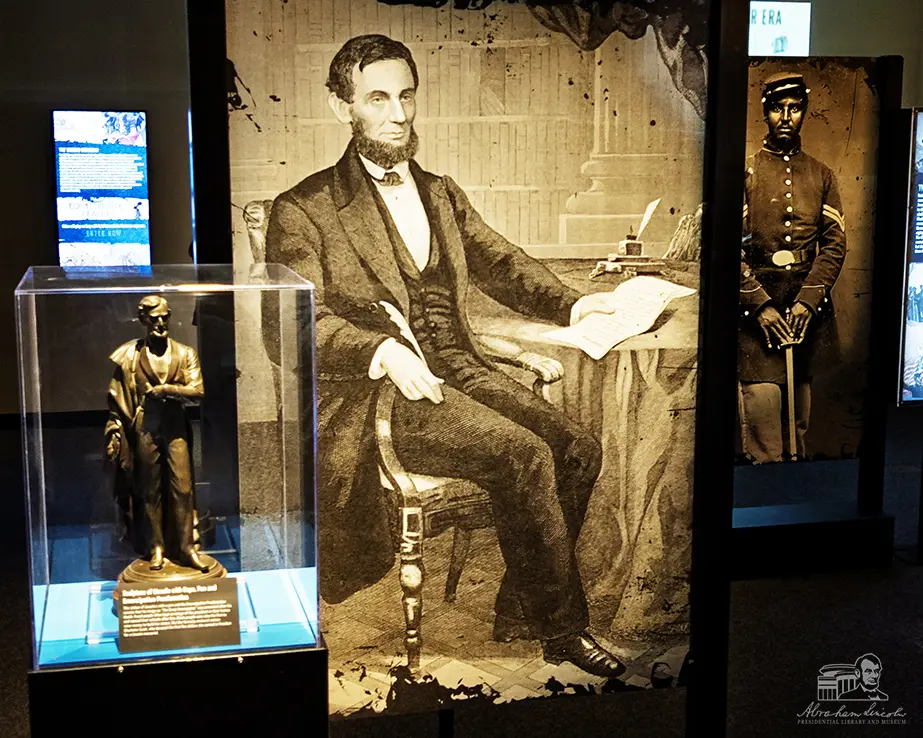 Part of "The Second American Revolution"
A highlight of the exhibit is the pen Lincoln used when signing the Emancipation Proclamation on Jan. 1, 1863. A few scratches with this piece of wood and steel put America on a path toward freedom for millions of enslaved people. The pen is on loan to the ALPLM from the Massachusetts Historical Society.
Another highlight is the ALPLM’s copy of the 13th Amendment, signed by Lincoln and many congressional supporters. The amendment did permanently what the Emancipation Proclamation had done temporarily – free millions from slavery. The document is so fragile that it has not been publicly displayed in years, but an exhibit case with new technology to protect the paper and ink now makes a display possible. The amendment will be in the exhibit for about six weeks, then removed until December and the anniversary of the amendment’s ratification.
The mission of the Abraham Lincoln Presidential Library and Museum is to inspire civic engagement through the diverse lens of Illinois history and share with the world the life and legacy of Abraham Lincoln. We pursue this mission through a combination of rigorous scholarship and high-tech showmanship built on the bedrock of the ALPLM’s unparalleled collection of historical materials – roughly 13 million items from all eras of Illinois history.
You can follow the ALPLM on Facebook, X/Twitter and Instagram.
Legal Disclaimer:
EIN Presswire provides this news content "as is" without warranty of any kind. We do not accept any responsibility or liability for the accuracy, content, images, videos, licenses, completeness, legality, or reliability of the information contained in this article. If you have any complaints or copyright issues related to this article, kindly contact the author above.
